
Book Online

How to stay safe when driving in floods

Driving in floods is often more dangerous than people realise, and the Gov.uk reported that it can take as little as 30cm of flowing water to wash a car away, yet 74% of drivers would still risk driving in these conditions. Thankfully if you find yourself in a flood for no fault of your own, or have an emergency, we are here to help, providing you with all the safety tips you'll need when flooding might be present.

Download our app
Flooded Roads

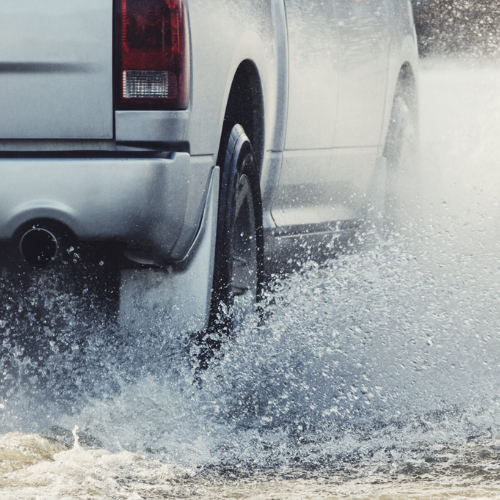
One of the biggest impacts when driving on flooded roads is the reduced grip. When water is collected on the road surface a layer is formed between the road and your tyres. As a result these can have massive impacts on your stopping distances, which can be up to 4 times the usual amount.

What to do before setting off

Before setting off, the first thing to consider is whether your journey is truly essential and if it isn’t, it’s best to stay at home. If for whatever reason you need to travel or find yourself in a flood, here are a few of our best tips. These will ensure you drive safely during the winter months and you are ready for whatever the weather might throw at you.

  • Flood depth and road conditions – make sure to check your local weather and road conditions before setting off to ensure it is safe to travel.
  • Tyre conditions – make sure you have the right tyres fitted and that they have sufficient tread depth to keep you safe on the roads.
  • Visibility – driving in floods and heavy rain can significantly impact your ability to see what is ahead of you. If you do not have clear vision through your windscreen and mirrors, it is safest not to travel.
  • Brakes – test that your brakes feel normal and check that no warning signs are showing on your dashboard, as prolonged exposure to rain and water can accelerate corrosion.

HOW TO DRIVE IN FLOODS

Driving in floods should always be a last resort and if the journey is not necessary then it is best to stay at home. But if you find yourself out and about and you have no other options here are a few tips to keep you and your car safe.

  • Check the depth of the water – it can be very hard to judge from inside your car, so if safe to do so try to check the depth using a stick or a long pole before attempting to cross – doing so with caution. It is important to avoid driving through anything over 10cm in depth.
  • Drive slowly – make sure to keep travelling at a steady speed, maintaining revs throughout to prevent stalling. This is also best done in a lower gear, helping maintain steady power.
  • Don’t follow other cars – don’t attempt to go straight after other vehicles in the case that they stall or break down in front of you. Otherwise you might not have anywhere to pass and end up becoming stranded yourself.

How to drive through a ford?

Driving through fords is very similar to driving through floods and it is important to take the same precautions before passing. If you see either of these dangers and are uncertain about crossing it is best to try to find another route. Do not cross if:

  • There is fast flowing water
  • You don’t know the depth
  • There is debris in the water

WHAT TO DO AFTER DRIVING IN FLOODS

Just because you have got through floods safely doesn’t mean you are out of trouble. This is due to some mechanical issues taking hours, days or even weeks to happen and it could cause you to become stranded later on. These are the key things to check after you have crossed any deep waters or floods.

  • Break checks – make sure they feel normal and no warning signs are shown on the dash.
  • Engine checks – if you open the bonnet and can see any standing water, mud or loose belts then you will need to seek help before continuing your journey.
  • Engine oil – make sure no water has impacted the purity of your oil. The oil should be a dark thick consistency.
  • Electric systems – water and electrics do not mix well. With the number of features modern cars have, it is important to check that everything is working correctly after driving through flood water, including headlights, parking sensors and cameras.

Does car insurance cover flood damage?

This very much depends on the insurance you have and the causes of the damage, but usually yes. Insurance often covers you for unavoidable circumstances such as, heavy rain, flash floods and overflowing rivers. However, claims can become more complicated when you ignore the risks and the damage was avoidable, in which case this is usually your wrong doing, and hence often making you uninsured.

It is important to understand how insurance works and before you travel make sure what you are covered for – be sure to check with your insurance provider.

Stay safe this winter with RED

Knowing when it is safe to drive in floods can be one of the hardest parts to consider and this is especially the case for newly qualified drivers who may not know the dangers they could face.

At RED we don’t think learning should stop from when you pass your test and our Newly Qualified Driver app is packed with helpful resources and guidance to help you handle whatever winter throws at you. We provide you with all the safety tips to keep you out of trouble and offer advice for when travel might not be the best option.


FAQs

Can you drive through flood water in an electric car​?

Yes, driving through floods in an electric car is generally considered safer than in a petrol or diesel vehicle, as electric cars tend to be better sealed. However, it is still important to remember that they are not designed for these kinds of journeys and are not fully waterproof.

If water does get into the electrical systems, the damage can be significantly more costly to repair. This can cause high voltage systems to cut out, and in some cases fires can occur if the lithium batteries are damaged, which can happen weeks after the initial incident. It’s therefore best to follow the same safety precautions as you would in any other vehicle.

Can driving through puddles damage your car?

When driving in the rain, puddles can appear very quickly as tarmac is often unable to drain water fast enough. Standing water not only increases stopping distances but can also cause serious damage to your vehicle. The extent of this damage depends on the speed you are travelling at, as water can spray into key mechanisms such as the engine, exhaust and brakes. It is therefore advisable to slow right down or avoid larger puddles altogether when it is safe to do so.

How to drive through flood water in an automatic car​?

The safest way to drive through floods in an automatic car is to first check the depth of the water, as even small amounts can cause serious damage. Make sure to drive slowly in a low gear, keep your revs constant, leave plenty of space from the vehicle in front and avoid changing gears mid crossing. If the journey is not essential then it is best not to travel at all, as driving in floods poses serious dangers to both your safety and your vehicle.