Book Online

Everything you need to know about car stopping distances

Knowing your vehicle’s stopping distance is something that can go unnoticed and can be all too quickly forgotten in our day-to-day driving. In fact, tailgating is one of the biggest causes of road accidents in the UK. So, whether you’re studying for your theory test or revising the rules of the road, we’re here to help.

Download our app

What is stopping distance?

In simple terms, stopping distance is the distance that it takes to bring a moving vehicle to a complete stop. This includes the time it takes to realise the hazard, react to it and bring the vehicle to a complete stop. Here is a simple formula below.

Stopping distance = thinking distance + braking distance


What is thinking distance?

Thinking distance is the distance a vehicle travels in the short time between a driver noticing a hazard and reacting by applying the brakes. Although this reaction time is usually less than a second, the vehicle continues moving at its current speed during this period. As a result, the faster the vehicle is travelling, the greater the thinking distance will be.

How much stopping distance should I leave?

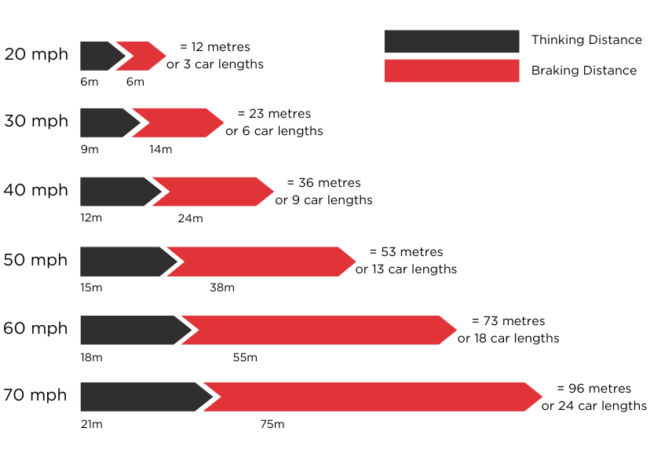
The following stopping distances are a useful guide from the Highway Code. The data is based on an average sized family car, stopping in normal weather conditions. As you’ll see, the faster a car is travelling, the longer it takes to stop. Travelling at 40mph rather than 30mph for example, means it will take 13 more metres to stop the car, which is equivalent to 3 averaged sized cars.


How do you calculate stopping distance?

To calculate stopping distance, you use the formula below, which includes both the time it takes to react and begin braking, as well as the time it takes for the car to come to a halt.

Stopping distance (feet) = Speed (mph) × Interval

The interval starts at 2.0 for 20mph, increasing by 0.5 for every 10mph (20mph = 2.0, 30mph = 2.5, 40mph = 3.0, 50mph = 3.5)

For example:

  • 30mph × 2.5 = 75ft (~23m)
  • 60mph × 4 = 240ft (~73m)

What will affect your vehicle’s stopping distance?

Stopping distance is determined by more than just speed and in truth, there are many factors that influence the stopping distance of a vehicle. They can broadly be put into categories which affect both thinking and braking times. We take a look at each in more detail below:


Weather conditions

  • Rain: Driving in wet conditions significantly increases stopping distance because water reduces the friction between your tyres and the road surface. This means your tyres have less grip, making it harder for your vehicle to slow down effectively. In heavy rain, stopping distances can double compared to dry conditions. There is also a risk of aquaplaning, where tyres lose contact with the road entirely, making braking and steering much less effective.
  • Snow & Ice: In wintery conditions, snow and ice can become compacted in the tyre tread which greatly reduces the effectiveness of the tyres and their grip on the road. This can lead to sliding and stopping distances up to 10 times greater than on a dry road.

Vehicle conditions

  • Brakes: Not surprisingly the condition of your car’s brakes will affect its braking distance; so keeping them in good working order is important. You may find it takes longer than usual for your brakes to slow your car down if they are becoming worn or have been poorly fitted. It’s also worth noting that cars fitted with ABS will encounter little difference in terms of stopping distance. ABS is designed to give more control to the driver in an emergency brake situation rather than stopping the vehicle quicker.
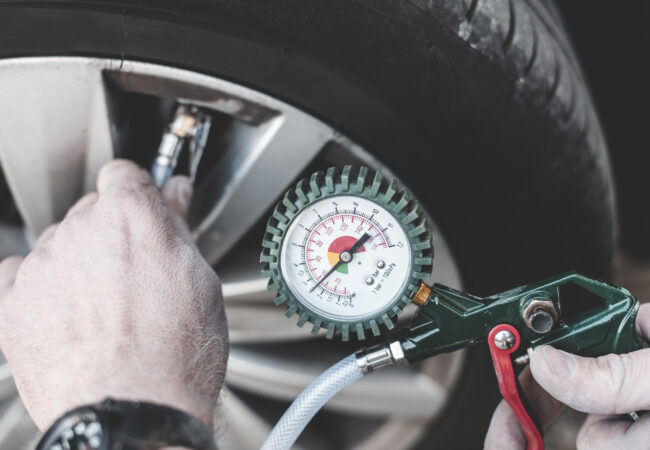
  • Tyres: Worn or incorrectly-inflated tyres negatively affect your car’s stopping distance. Older tyres, with a reduced tread (less than 3mm) will have a greater stopping distance than newer tyres with a deeper tread (8-7mm). This is because worn tyres have much less grip on the road. Overinflated tyres also result in less road grip, so it’s important to regularly check the condition of your tyres.
  • Vehicle Size & Weight: Larger and heavier vehicles have a longer braking distance than smaller, lighter vehicles. Why? It’s all to do with physics and the fact that more force is required to stop a heavier vehicle.

Driver awareness

  • Tiredness: Driving tired can severely affect reaction time as well as your attention and awareness regarding what’s happening on the roads. The longer you take to react the further your stopping distance is going to be. It’s therefore recommended that you take a break every 2 hours on long journeys.
  • Distractions: Whether it’s in car tech, talking to passengers or fiddling with the heating, it can be all too easy to become distracted when driving. Distractions can quickly lead to a lack of focus on the road leading to increased stopping distances and a greater risk of accidents.
  • Stress & Emotions: Stress and pressure are a common part of our busy lives but they can have a big impact on our driving. Whether you’re running late, desperate to get home after a long day at work or experiencing a case of road rage. Feelings of stress and pressure can lead to higher speeds, shorter separation gaps and slower reaction times.
  • Drink & Drugs: It goes without saying that you shouldn’t drink and drive, and it is also illegal to drive under the influence of certain drugs. Why? Because consuming alcohol and drugs increases the time it takes to process information such as hazards on the roads and therefore increases your stopping distance.

Other issues

  • Road Conditions: Be aware that spillages, and damaged or muddy roads can also increase stopping distance. In fact, any poor-quality surface that reduces the friction between your tyres and the road is inevitably going to have a negative effect on your braking.
  • Other Road Users: Whilst you cannot control the actions of other road users it’s important to allow for a ‘margin-of-error’ in your driving. Allowing plenty of space in front, behind and to the left and right of your vehicle should prevent any accidents. If you feel you’re being tailgated simply pull over safely and let the vehicle pass.
  • Field of Vision: How far and clearly a driver can see also has a significant impact on stopping distance. Fog, for example, can massively impact your field of vision, giving you less time to respond to the hazard or vehicle stopping in front of you.

Highway code stopping distance in the UK

The Highway Code’s stopping distances are intended as a guide rather than a guarantee, helping drivers understand the minimum space needed to stop safely under ideal conditions. The highway code thinking distance is also based on reaction times of 0.7 seconds, so variations with driver alertness can massively increase these distances. This is why the Code encourages drivers to keep at least a 2 second gap between the vehicle in front.

The 2 second rule is a quick and practical way of checking your stopping distance when you are travelling in your car. This is best used as a rough guide and more accurate when done at higher speeds. The purpose of this is to show drivers the impacts of stopping distances when travelling at greater speeds. This isn’t 100% accurate as it doesn’t account for thinking distances, weather conditions and other distractions, but it is a great way to show drivers how much distance is travelled in a short period of time.

Supporting newly qualified drivers

Whether you’re new to driving or have years of experience, knowing your stopping distances is a crucial part of staying safe on the roads. Leaving enough distance between you and the car in front lets you react and stop in time if cars ahead suddenly brake, helping to avoid any costly accidents.

At RED, we support those who are learning to drive, but also those who have just passed and are new to the road. There is still lots to learn about being behind the wheel, and our Newly Qualified Driver app provides a range of helpful resources and further information to help you become a confident driver.

Download our RED app today and continue learning.

FAQs

How does heavy rain affect stopping distance?

Heavy rain significantly increases stopping distances because it reduces the grip between your tyres and the road. Water creates a thin layer that makes it harder for tyres to maintain contact with the surface, meaning your vehicle takes longer to slow down and stop.

Stopping distances can actually double in the rain so it is very important to:

  • Reduce your speed
  • Increase the gap between you and the vehicle in front
  • Brake more gently and earlier than usual


Does ABS shorten stopping distance?

ABS (Anti-lock Braking System) doesn’t always shorten your stopping distance, but it can help you stay in control. In emergency situations, ABS prevents your wheels from locking up, meaning you can stay in control of your vehicle and reduce chances of skidding. This doesn’t tend to affect stopping distances and can sometimes make it slightly longer in slippery conditions but the main benefit is helps you to stay in control and not spin out.


How does speed affect stopping distance?

Speed has a major impact on stopping distance and it increases much faster than most new drivers expect.

As your speed rises:

  • Your thinking distance increases (you travel further before reacting)
  • Your braking distance increases dramatically because the vehicle has much more energy to lose

In fact, doubling your speed can more than double your stopping distance. For example, going from 30 mph to 60 mph doesn’t just double the distance, it can increase it by around four times. That’s why even small increases in speed make a big difference and making sure you keep your distances from vehicles in front is very important.


How much can stopping distance increase in icy conditions?

Ice conditions are some of the most dangerous driving conditions and often one of the hardest to spot. Unlike rain or snow, it can be nearly invisible, leaving little time to react before losing control.

When driving in snow/icy conditions it is important to slow down, brake gently and leave plenty of space between you and the vehicle ahead. This distance needs to be significantly more than normal as braking distances can be 10x further, to standard stopping distances.


What is the stopping distance at 30mph?

At 30 mph, the typical stopping distance is around 23 metres, which includes both thinking distance and braking distance. The thinking distance at 30mph is about 9 metres and the braking distance is about 14 metres. It’s important to remember these distances can increase significantly in poor conditions such as wet or icy roads, or if the driver is tired or distracted.

What is the stopping distance at 70mph?

At 70 mph, stopping distances increase dramatically, reaching around 96 metres in total. At this speed, even small delays in reaction or slight changes in road conditions can have a big impact on how far the vehicle travels before stopping, hence why adhering to speed limits is so important.