LIMITED TIME OFFER: Save 37% on RED Driving Instructor training.

Book Online

A beginner’s guide to Motorways in the UK

There are many Motorways within the UK that all provide fast and efficient links between towns, cities, and regions. Whether you are new to driving in Britain, preparing for your test, or simply refreshing your knowledge, understanding how to drive safely and confidently on motorways is essential.

Download our app

Pass your test with RED

Keep your driving skills sharp with the Learn To Drive with RED app. Download the app, get a free 30-day trial plus access to practice theory test content

What is a Motorway?

Motorways are high-speed, multi-lane roads designed for long-distance travel and capable of handling large traffic volumes. They are identified by blue road signs and are legally restricted from use by pedestrians, cyclists, mobility scooters, agricultural vehicles, and learner drivers (unless they are driving with an approved instructor in a dual-controlled car).
Motorways include:

  • Two or more lanes in each direction
  • Central reservation barriers
  • Slip roads for joining and exiting
  • Clear signage and road markings

Speed limits on UK Motorways

The speed limit on UK Motorways varies depending on the vehicle type and whether there are signs indicating a change in speed, which often happens if there are road works, an accident or bad weather.
The speed limits are the following:

  • 70 mph for cars, motorcycles and most light vehicles
  • 60 mph for vehicles towing trailers
  • 70 mph for buses and coaches unless they exceed 12 metres in length, and therefore the limit is 60mph
  • 56 mph for heavy goods vehicles (HGVs)

Remember: speed limits are maximums, not targets. Drivers should always adjust to traffic, weather, and visibility conditions.

Motorway signs and their meanings

Understanding motorway signage is a must when learning how to drive. A motorway sign is typically blue with white text and symbols, but they can differ. Here are the essential signs and their meanings:

Direction signs

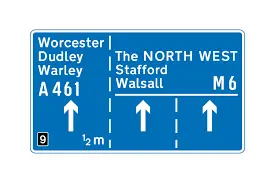
Blue background signs provide directions, junction numbers and destinations.

Advisory speed limit sign

These appear on smart motorways or overhead gantries. They display a suggested maximum speed. They are not legally enforceable unless displayed inside a red circle.

Variable speed limit signs

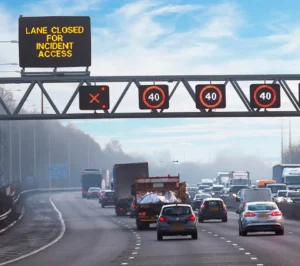
These signs are shown on overhead gantries, which display temporary limits that are legally enforceable. This could be due to road works, an accident or bad weather.

Lane control signals

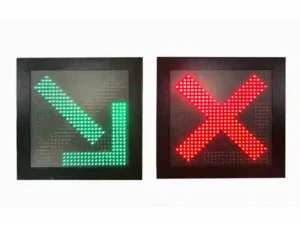
A green arrow means that the lane is open. If you are to see a red cross (X), then this indicates that the lane is closed and therefore you need to safely change lanes immediately.

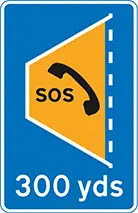
Emergency signs

These signs indicate that there is an SOS layby in which you can safely indicate to move over. There will be a telephone that you can use to call the National Highways control for assistance.

Service area signs

These signs are shown when a service area is approaching. This can be rest stops for fuel, food and parking.

Motorway exit signs

A motorway exit sign shows an approaching junction with road numbers and destinations. They are positioned 1 mile before the exit, 0.5 mile before and at the exit slip road.

How to drive on a Motorway in the UK

Driving on a motorway can seem daunting for new drivers, and it is advised (if possible) to practice with your qualified driving instructor in a dual car. The key is understanding the rules, observing traffic behaviour, and maintaining your safety and confidence.

Preparing your journey before joining the motorway

Before you join the motorway, it is always best to know your route in advance. Motorway navigation can be stressful if you are uncertain about junctions. Using a satnav or checking the route ahead helps avoid last-minute decisions. You also want to make sure you have enough fuel before going on the motorway and have knowledge of where the next petrol station is.

Joining the motorway from a slip road

Slip roads are designed to help you increase speed (usually between 50-70 mph) to match the traffic already on the motorway. Use the mirror-signal-manoeuvre (MSM) routine and don’t forget to check your blind spots before safely merging into the first lane.

Lane discipline and overtaking

Good practice on a motorway is primarily about maintaining consistent lane discipline and safely overtaking when necessary.

  • The left-hand lane is the default lane for driving
  • The middle lane or lanes are used for overtaking slower traffic in the left-hand lane.
  • The right-hand lane is used to overtake those in the middle lanes.

Always remember to use your mirrors carefully when changing lanes and signal to let others know your intentions. You should always reposition yourself back to the left-hand lane once you have safely overtaken, rather than remaining in the middle or right-hand lanes, as this can cause congestion.

Keep a safe distance from other vehicles

Higher speeds mean longer stopping distances between you and the car in front. In dry conditions, you need to remain at least 2 seconds behind the vehicle in front, in wet conditions, at least 4 seconds and in icy conditions, you need to leave a much larger gap between the vehicle in front (up to 10 times the normal distance) at a reduced speed.

Smart motorways

Smart motorways are a modern development from standard motorways and are designed to improve traffic flow and reduce congestion. A smart motorway uses electronic systems, cameras and sensors to control traffic, detect breakdowns and accidents. This allows traffic officers to respond quickly to avoid longer congestion.

There are three main types of smart motorways in the UK:

  • Controlled motorways uses variable speed limits shown on overhead gantries and has a hard shoulder available for emergencies.
  • All lane running (ALR) motorways have no hard shoulder, and emergency areas that are roughly a mile apart.
  • Dynamic hard shoulder motorways have a hard shoulder that can be opened as an active lane during peak times. The signs on the overhead gantry indicate whether this is open or closed.

Additional rules for smart motorways

The rules for smart motorways are the same as standard, but with some additional regulations:

  • Speed limits can change depending on traffic flow, roadworks, weather and accidents. These will be displayed in a red circle on the overhead gantry and are legally enforceable.
  • Lanes that have a red cross (X) must not be driven in, as this indicates that there is an incident ahead. If you do drive in this lane, it can result in a penalty charge.
  • Use of emergency areas is marked with blue telephone signs and needs to be used as best as possible, as there is no hard shoulder. If you can’t reach an emergency area, then you must move as far to the left as possible and put your hazards on. When safe to do so, exit the vehicle and stand as far away as possible from the motorway and your vehicle before calling for assistance.

Motorways during a driving test

During your practical driving test, motorways are not included for learners; however, examiners can guide you to similar high-speed situations, such as dual carriageways. Many driving instructors will recommend having at least one lesson on the motorway before driving independently once you have passed your driving test.

Lean more on dual carriageways

FAQs

What is the speed limit on UK motorways?

The standard speed limit on UK motorways is 70 mph for cars and motorcycles. However, different limits apply to other vehicles, such as vehicles towing trailers, large goods vehicles and buses/coaches that should keep to 60 mph maximum.

Speed limits may apply on smart motorways and during roadworks.

Can learner drivers go on motorways?

Yes, but with certain conditions. Learner drivers must be with a qualified driving instructor in a dual-controlled car. Learner drivers can not go on the motorway alone, and it is not part of the practical driving test.

Is motorway driving included in the UK driving test?

No, motorway driving is not part of the practical driving test. However, dual carriageways with similar speeds may be included. Many instructors recommend taking additional motorway lessons after passing the test.

You may also be interested in…

Learn To Drive With RED app

Find out more

The cornerstone of learning to drive efficiently is being able to monitor and track your progress to test success, and our new app, Learn To Drive With RED, puts learning to drive in the palm of your hand.

Find out more

Dual carriageway

Read more

Learn everything you need to know about driving on dual carriageways, including speed limits, signs, and top tips for staying safe and confident behind the wheel.

Read more

Roundabouts

Learn more

For many student drivers, roundabouts are one of the more challenging parts of driving. With the right knowledge, you can approach any roundabout with confidence and ease.

Learn more
Download the Learn to Drive with RED app
4.5800 ratings 4.5 out of 5 from 800 ratings