 0330 332 2680
  Book Online
  Login MyRed
How to navigate a roundabout
For many student drivers, roundabouts are one of the more challenging parts of driving. With the right knowledge, you can approach any roundabout with confidence and ease.
Download our app

Get a 30-day free trial of our app and start learning your theory today!



Get flexible learner driver insurance today.
Get a quoteLearn with RED. Practise with VeygoFor many student drivers, roundabouts are one of the more challenging parts of driving. With the right knowledge, you can approach any roundabout with confidence and ease.
Download our app
Keep your driving skills sharp with the Learn To Drive with RED app. Download the app, get a free 30-day trial plus access to practice theory test content.


A roundabout is a circular junction designed to keep traffic moving smoothly and safely. Vehicles travel clockwise around a central island, and drivers entering must give way to traffic approaching from the right.
There are different signs to tell drivers that there is a roundabout ahead:

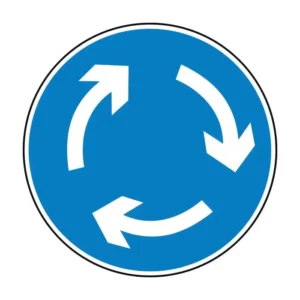
Approaching a roundabout can be daunting, but knowing the rules of how to use it correctly and practising with your driving instructor can make this junction easy to navigate.
The key thing to remember is to use the mirror, signal, manoeuvre (MSM) routine:
One of the most common questions learners ask is who has the right of way when navigating a roundabout. When you approach, slow down and give way to vehicles from your right, unless the roundabout has traffic lights, in which case traffic to your right will be at a red light. The vehicles that are already on the roundabout always have priority.
If you’re going straight ahead, you should not signal on approach. You should select the correct lane (usually the left or middle lane, depending on road markings). Stay in the lane and only signal left after you have passed the exit before. This will let other road users know that you are exiting.
Roundabouts have a range of exits depending on the size, so there are a variety of scenarios for exiting. Here is how to approach each scenario:
When exiting to the left, which will be the first exit, approach the roundabout in the left-hand lane and signal left. Keep left as you join and maintain the signal until you exit. Watch for pedestrians or cyclists crossing the exit road.
Turning right at a roundabout means that you need to join the roundabout on the right-hand lane and follow the roundabout round. When approaching, make sure you are in the right-hand lane, unless signs say otherwise, and you have signalled right on approach, so other road users know your intention.
Keep to the right as you join the roundabout and begin to circle the central island. After passing the exit before yours, signal left and check mirrors before moving across to exit safely.
Mini roundabouts follow the same rules as standard ones, but the junction is smaller. When approaching a mini roundabout, you’ll see the sign, and the central island is a painted circle.
Make sure when you approach a mini roundabout, you follow these rules:
During your driving test, you will join at least one roundabout. This is why it is important to build your confidence and practise with your driving instructor during your lessons. Here are things to remember:

Vehicles that have already joined the roundabout have priority. Drivers entering must give way to vehicles from the right, unless directed otherwise by road markings or signals.
Stay calm and continue driving, being careful not to cross over lanes or stop in front of traffic. The best thing about a roundabout is that it is round, and therefore, you can redo and leave safely when approaching your exit again.
On standard roundabouts, the central island must not be driven over. On mini roundabouts, the painted circle can be overrun by larger vehicles if necessary, but you should avoid it in a car. When larger vehicles are on a roundabout, it is best to keep your distance and stay behind them until they exit.
Yes, cyclists may stay in the left lane even when going right. This is for their own safety as it helps cyclists avoid moving across faster-moving traffic. Lane changes on busy roundabouts can be risky for vulnerable road users. Always give them space and avoid overtaking unless it is safe.
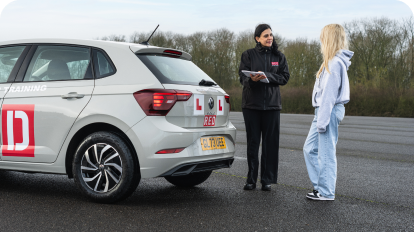
The cornerstone of learning to drive efficiently is being able to monitor and track your progress to test success, and our new app, Learn To Drive With RED, puts learning to drive in the palm of your hand.
Find out more
Learn everything you need to know about driving on dual carriageways, including speed limits, signs, and top tips for staying safe and confident behind the wheel.
Read more
Whether you are new to driving in Britain, preparing for your test, or simply refreshing your knowledge, understanding how to drive safely and confidently on motorways is essential.
Learn more