LIMITED TIME OFFER: Save 37% on RED Driving Instructor training.

Book Online

A guide to driving in fog

Driving in thick fog can be worrying, but driving in foggy conditions doesn't have to be scary once you know what you're doing. In this guide, we'll walk you through everything you need to know about driving in fog. You'll learn what fog actually is, why it's so challenging, everything about fog lights, and how to drive safely in fog.

Download our app

Pass your test with RED

Keep your driving skills sharp with the Learn To Drive with RED app. Download the app, get a free 30-day trial plus access to practice theory test content

What is fog and why is it difficult to drive in?

Fog is essentially a cloud that forms at ground level, made up of tiny water droplets. You’ll typically see it early in the morning or evening, especially near rivers, lakes, or coastal areas, but it can appear at other times too.

Here are the challenges with driving in the fog:

  • Reduced visibility: In thick fog, you might only be able to see a few metres ahead of your car. Hazards, other vehicles, pedestrians, and road signs can appear suddenly with almost no warning.
  • Optical illusions and misjudging speed: It can make you think you’re driving slower than you actually are, which leads to unintentional speeding. You might also find it hard to tell if the car ahead of you is moving, stopped, or parked. Judging distances becomes really tricky.
  • Slippery road conditions: all those water droplets settle on the road surface, making it slippery. This means your stopping distance in fog increases.
  • Unpredictable fog density: fog doesn’t stay the same thickness. One minute, you might be driving through light, patchy fog where you can see reasonably well. Next, you’ve hit a thick bank of fog where you can barely see a few feet ahead. You might also encounter fog on road signs saying “Fog” but find the road clear; this is a warning that there’s patchy fog ahead.

Most fog accidents are preventable when you adjust your driving properly.

Preparing your car for driving in fog

Before you set off in foggy conditions, make sure your car is safe and ready for the journey ahead, whether short or long.

Clean your windows

Fog already limits your visibility, so don’t make it worse with dirty windows. Give your windscreen, side windows, and rear window a proper clean, inside and out.

Make sure you know how to demist your windscreen quickly. Fog creates moisture that steams up your windows. Practise using your demister and defroster controls: turn on the heater, direct airflow to the windscreen, and turn on the air conditioning. Some modern cars have a “demist” button too.

Check your lights

Your lights are crucial in fog, for seeing where you’re going and making sure other drivers can see you. Before driving, check that all of these are working:

  • Headlights (dipped and main beam)
  • Fog lights (front and rear, if your car has them)
  • Brake lights
  • Indicators

Top up your washer fluid

You’ll be using your windscreen wipers frequently in fog, so check your washer fluid is topped up. The moisture from fog creates a film on your windscreen that needs regular clearing.

Check your fuel or charge levels

Make sure you have enough fuel or charge for your journey, with some extra to spare. Driving in fog takes longer than normal, and breaking down in foggy conditions is particularly dangerous – other drivers might not see your stationary car until they’re dangerously close.

Plan extra time

Allow more time for your journey than you normally would. You’ll need to drive more slowly in fog, and you might need to pull over and wait if conditions get too bad.

Tips for driving in fog

Once you’re on the road, adjust your driving to the low-visibility conditions. Other drivers may struggle to see you, too.

Reduce your speed

This is the most important driving in fog safety tip. Reduce your speed as you need enough time to spot hazards and stop within the distance you can actually see. Fog also makes roads slippery. Fog makes you feel like you are driving slow so make sure you are regularly checking your speedometer.

Use the correct lights

Use dipped headlights when driving in fog, even in daylight. Never use high beams as they reflect off the fog and reduce visibility. If available, use fog lights when visibility drops below 100 metres.

Increase your following distance and use road markings as a guide

Increase your gap significantly to at least 4–5 seconds, if not more. Slippery roads and poor visibility mean longer stopping distances. Use lane markings and roadside reflectors to stay positioned, especially on bends and at junctions.

Keep your windscreen clear

Fog adds moisture quickly. Use wipers, demisters, and ventilation to prevent misting. Open a window slightly if needed.

Turn off cruise control

Keep full control of your speed. Fog can hide hazards, and you may need to react instantly.

Listen as well as look

Turn down the radio and open a window slightly. Use sound to detect traffic you can’t see yet.

Avoid overtaking and unnecessary lane changes, and know when to pull over

Don’t overtake as you can’t see far enough ahead. Stay in your lane and drive predictably. If visibility becomes just a few metres, pull over safely and wait for conditions to improve.

What are fog lights, and when should you use them?

Fog lights are not lights that are used all the time, and so learners may not know what they are and where to find them. Let’s break down exactly what they are and when you’re legally allowed to use them.

What fog lights are

Fog lights are lights on your car designed specifically for foggy conditions. They’re different from your normal headlights in a few key ways:

  • Rear fog lights: Every car in the UK must have at least one rear fog light by law. These are red lights mounted low down on the back of your car, typically below your brake lights. Their job is to make you really visible to drivers behind you when fog makes it hard to see.
  • Front fog lights: Not all cars have these, and they’re not a legal requirement. If your car does have them, they’ll be mounted low down on the front, often below the main headlights or below the bumper. They’re usually white or yellow. Front fog lights are angled downwards towards the road, so they light up the road surface right in front of you without the light bouncing back off the fog into your eyes.

Understanding the fog light symbol

Every car has different controls. Your fog lights might be controlled by:

  • A button on the dashboard
  • A dial near your headlight controls
  • A stalk on the steering column that you twist, pull, or push

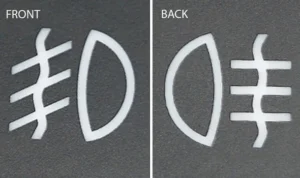
The fog light symbol shows a lamp with three diagonal or wavy lines passing through a vertical wavy line (the wavy line represents fog). This is how you know when to use fog lights and when they’re switched on. Please note that symbols can vary depending on your car’s make and model.


Rear fog light symbol: When your rear fog lights are on, an amber or orange warning light appears on your dashboard with one wavy line through it.

Front fog light symbol: If your car has front fog lights, a green warning light with two or three wavy lines will appear on your dashboard when they’re active.

The 100-metre rule

The Highway Code (Rule 226) states you can only use fog lights when visibility is seriously reduced, which is when you cannot see more than 100 metres (328 feet) ahead.

When to turn fog lights off

As soon as visibility improves and you can see more than 100 metres ahead, you must turn your fog lights off. This is a legal requirement, not just a suggestion. It’s really easy to forget to turn them off, especially if you drove into fog, waited it out, then continued your journey. Get into the habit of checking. You’ll usually have a warning light on your dashboard showing they’re on.

FAQs

Can I have my driving test in fog?

Your driving test might not go ahead if there’s heavy fog. If visibility is considered too dangerous, the test centre will cancel your test, and you’ll need to rebook. If you’re worried about weather conditions on your test day, check your emails for updates from DVSA and consider calling the test centre to check if tests are going ahead.

What's the difference between fog lights and normal headlights?

Normal headlights (dipped and main beam) are mounted higher up on your car and are angled to light up the road ahead of you. Main beam points quite far ahead and up, which is great in normal conditions but terrible in fog, as the light just bounces back at you off the moisture droplets.

Fog lights are mounted much lower and angled downwards towards the road surface directly in front of you. This positioning helps them cut through or even shine under fog without creating blinding glare. Rear fog lights are specifically designed to be super bright so vehicles behind you can spot you in poor visibility.

Can I drive in fog as a learner driver?

Yes, you can drive in fog as a learner driver, as long as you’re supervised by a qualified driver (someone over 21 who’s held a full licence for at least 3 years). In fact, it’s beneficial to practise driving in different weather conditions during your learning period, including fog if you get the opportunity. You could ask your instructor about booking a lesson if foggy weather is forecast.

You may also be interested in…

Learn To Drive With RED app

Find out more

The cornerstone of learning to drive efficiently is being able to monitor and track your progress to test success, and our new app, Learn To Drive With RED, puts learning to drive in the palm of your hand.

Find out more

Driving in the dark

Read more

Reduced visibility, glare from headlights, and fatigue can make even familiar roads feel challenging when driving late. We’ll explore how to prepare your car, adjust your driving, and stay alert to keep yourself and others safe in the dark.

Read more

Driving in the rain

Learn more

Learn everything you need to know about driving in the rain, from how to know your car is prepared to understanding stopping distances.

Learn more
Download the Learn to Drive with RED app
4.5800 ratings 4.5 out of 5 from 800 ratings